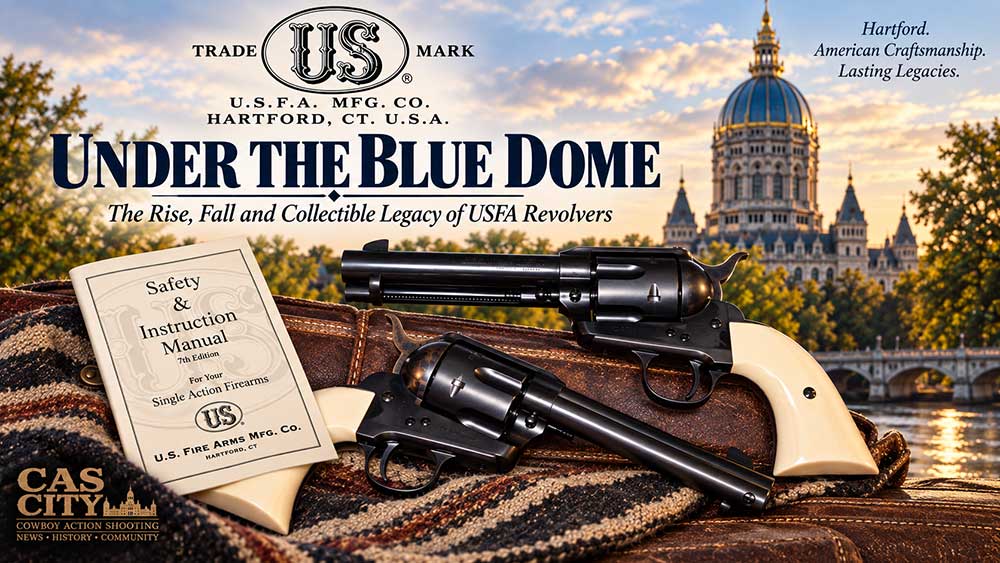
For a relatively brief period in American firearms history, some of the finest Single Action Army-style revolvers in the country were once again being manufactured in Hartford, Connecticut.
And remarkably, they were being built beneath one of the most recognizable landmarks in American firearms history: the famous blue onion dome of the old Colt Armory.
The company was U.S. Fire Arms Manufacturing Company—better known simply as USFA.
To Cowboy Action shooters in the 2000s, USFA revolvers weren’t obscure collectibles. They were working guns. Shooters bought them in pairs, had action jobs performed on them, changed grips, ordered unusual barrel lengths and calibers, and carried them through match after match.
Today, USFA is gone.
The revolvers are not.
Increasingly sought after by collectors and shooters, they represent an unusual chapter in American gunmaking: a company that set out to reproduce the classic Colt single action with modern precision, built a fiercely loyal following, and then walked away from the very revolvers that had made its reputation.
And here at CAS City, much of that story was being recorded while it happened.
Back to Hartford
The location could hardly have been more appropriate.
Samuel Colt established his Hartford manufacturing complex along the Connecticut River in the 1850s. The East Armory—with its distinctive blue onion dome topped by a gilded Rampant Colt—became an American industrial landmark.
Colt introduced the Single Action Army in 1873, and the revolver became one of the defining firearms of the American West.
More than a century later, Colt consolidated its remaining Hartford operations at its West Hartford facility in 1994.
But gunmaking wasn’t quite finished under the Blue Dome.
Douglas Donnelly founded what was originally called U.S. Patent Fire Arms Manufacturing Company in 1993. The fledgling company rented space in the historic Colt complex and initially assembled reproductions using components supplied by Uberti in Italy.
Those early guns are an important distinction for today’s collector. Early USPFA/USFA revolvers are not necessarily the same thing as the later Hartford-manufactured guns that established USFA’s reputation.
Over time, the company moved increasingly toward domestic production, eventually manufacturing its own major components and producing revolvers that were unmistakably American-made.
That evolution is documented unusually well in CAS City’s own archives.
Years later, USFA sales manager Gary Granger, who participated on the CAS City forum as Banjoman, explained details of the early guns to collectors, including differences involving Uberti frames and the firing-pin bushing or recoil plate.
It is exactly the kind of manufacturing minutiae that becomes important once ordinary shooters’ guns become collectible artifacts.
Building a Better Peacemaker
By the early 2000s, USFA had developed a reputation that went well beyond simply producing another Colt reproduction.
The company combined CNC machining and modern manufacturing tolerances with the dimensions, appearance and feel of traditional single-action revolvers.
Gun writers noticed.
Contemporary reviews repeatedly praised USFA revolvers for their fitting, timing, lockup and attention to traditional Single Action Army dimensions. Custom revolversmiths also began using USFAs as foundations for high-end work.
Cowboy Action shooters were reaching similar conclusions with their wallets.
The very first surviving post in CAS City’s USFA Collectors & Shooters Society archive dates to July 16, 2004.
Member FloraBama Kid had just ordered a pair of .45 Colt Rodeos.
He had been considering the purchase for months, finally put his money down and hoped the revolvers would arrive with consecutive serial numbers.
There was just one problem.
He wasn’t terribly fond of the Rodeo’s utilitarian appearance and was already planning to send them out for color case hardening.
That post is a wonderful snapshot of what the Rodeo represented.
The Working Man’s USFA
The Rodeo dispensed with the expensive polishing and traditional high-grade finish of USFA’s premium revolvers. Instead, it wore a simple matte blue-black exterior.
Underneath, however, it was still a USFA.
The Rodeo gave Cowboy Action shooters access to the company’s machining and fitting without paying for the cosmetic work of its more expensive models. It became one of the company’s most recognizable guns and was frequently sold in exactly the manner Cowboy Action shooters needed them:
in pairs.
USFA was paying attention to those shooters.
In January 2007, CAS City member Dead River Den publicly thanked USFA and Gary Granger after the company donated a certificate for a Rodeo—or credit toward another USFA firearm—to the Wolverine Rangers’ Range War.
He won it.
After receiving the revolver, he reported that even the Rodeo’s understated finish had grown on him.
Now he needed to save for another one.
That relationship with Cowboy Action Shooting mattered. USFA wasn’t simply manufacturing historical reproductions destined for display cases. Its guns were being bought, tuned, holstered and shot by the very community helping drive the renewed interest in traditional single actions.
More Than the Rodeo
USFA’s catalog eventually became remarkably diverse.
There were beautifully finished Single Actions and Pre-Wars, utilitarian Rodeos, the polished Cowboy, deliberately aged Gunslingers, Bisleys, Flat Top Targets, Sheriff’s Models, Snubnoses, Omni-Potent and Omni-Target revolvers, historically inspired models and numerous special configurations.
The company’s Old Armory Custom Shop took things considerably further, offering engraving and traditional finishing work.
USFA wasn’t merely duplicating one revolver.
It was exploring variations from different periods of Colt history and occasionally creating variations of its own.
The CAS City archive captures that experimentation almost month by month.
In November 2006, Granger told members that limited quantities of Snubnose and Omni models had begun shipping and that a Bisley was expected the following year.
In 2007, he explained that USFA had added machinery and employees and reduced the cost of manufacturing its core revolvers. Common configurations of Rodeos, Rodeo IIs, Cowboys and Single Actions were increasingly being stocked instead of produced only after an order arrived.
USFA appeared to be hitting its stride.
A Factory Representative in the Forum
One of the most remarkable aspects of the surviving CAS City archive is that this wasn’t simply a group of enthusiasts talking among themselves.
USFA was listening.
Gary Granger joined the board as Banjoman and told members in 2006 that he checked the forum at least every other day.
His posts became an extraordinary window into how the company operated.
Someone wanted a 7½-inch Rodeo?
They’d make it.
Want one in .44-40 or .44 Special?
USFA could accommodate that too.
When members asked technical questions, Granger explained engineering and manufacturing decisions. When questions arose about barrel lengths, he described how barrels were manufactured and why individual non-standard configurations required additional time and expense.
He even floated potential products directly to CAS City members.
In August 2006, Granger asked whether shooters would be interested in a single-action kit. USFA would perform the critical fitting and action work while the customer completed the remaining finishing.
Members responded.
A few days later, Granger reported that their opinions had been noted and appreciated—the idea had been discussed in a company meeting.
That interaction gives the CAS City archive unusual historical value today.
We aren’t simply reading what collectors believe USFA did twenty years later.
In many cases, we’re reading explanations from someone who worked there.
A Very Small American Gun Company
The archive also reveals something easily forgotten when looking at USFA’s beautifully finished products.
This was a small company.
Responding to complaints about unanswered emails in 2008, Granger explained that the employee handling much of the company’s email also took product photographs, printed manuals and developed marketing materials.
USFA employees multitasked because they had to.
That small-company reality could occasionally produce frustration.
One lengthy CAS City discussion involved delays and poor communication concerning a pair of revolvers. Yet even the frustrated buyer repeatedly distinguished between the communication problem and the gun itself.
After finally receiving one revolver, he described it as a beautiful firearm whose craftsmanship made him proud to own it.
He eventually owned several USFAs.
Other stories went the opposite direction.
In one instance, a member posted that his USFA revolver was shooting off-center.
Before the owner even contacted the company directly, Granger saw the discussion on CAS City, contacted him and arranged for the revolver to be returned to USFA.
For better and occasionally for worse, the relationship between this little Hartford factory and its customers could be remarkably personal.
Fresh From the Factory
CAS City’s connection to USFA wasn’t merely observational.
On August 3, 2006, CAS City founder Marshal Halloway posted on the USFA Collectors & Shooters Society board:
“My 2 Rodeos showed up on my doorstep today, so now it is time to join the USFA CSS outfit.”
Four minutes later, another post appeared:
“Fresh from the factory, came in today.”
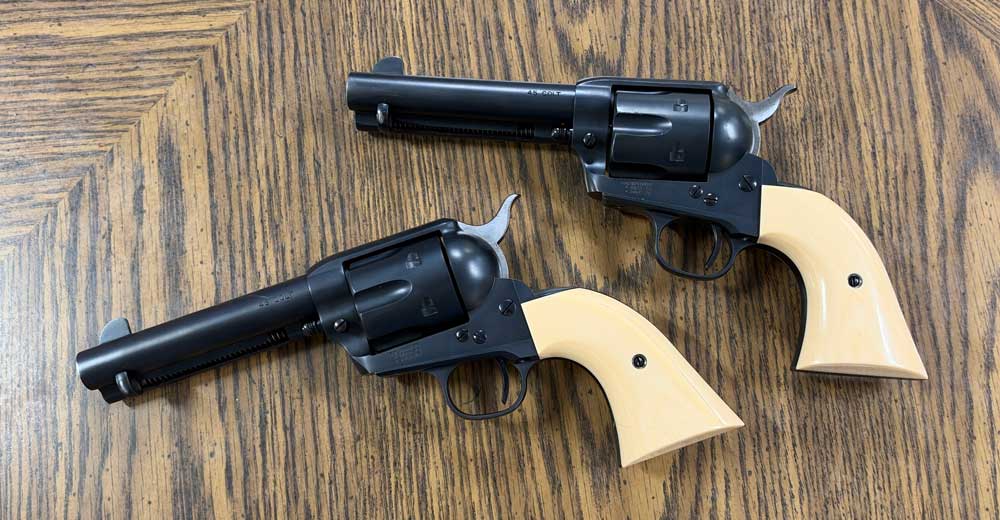
Attached was a photograph of the new revolvers—a consecutive pair of .45 Colt Rodeos, serial numbers K220 and K221, fitted with slightly aged Tru-Ivory grips.
The original photograph survives.
So do the revolvers.
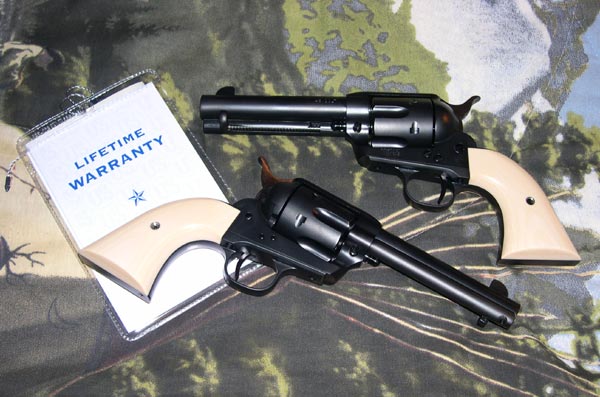
Twenty years later, K220 and K221 remain together.
They still wear the same grips.
Made in Hartford
By this period, USFA was emphatic about American manufacture.
Granger explained to CAS City members that special orders could take longer precisely because the company was making its own components. A revolver requiring an out-of-stock barrel or other part might have to wait for the next production run.
He described stages of manufacturing in surprisingly granular detail: barrel-and-cylinder fitting, action work, polishing and grip fitting, with some hand operations requiring considerable time.
In another discussion he described manufacturing markings used to identify steel lots, machining pallets and even a component’s position on a pallet—information that could help trace dimensional problems during inspection.
Even the packaging received attention.
Asked about USFA’s American-made claims, Granger noted that the company’s black presentation box was manufactured in Hartford only about half a mile away, while its cardboard sleeve and foam liner were also produced in Connecticut.
USFA wasn’t hiding from its identity.
It was selling it.
Hartford. American made. Under the Blue Dome.
Hollywood Came Calling
USFA’s revolvers also found their way onto movie screens.
Firearms specialist Thell Reed selected USFA revolvers for major Western productions including 3:10 to Yuma and The Assassination of Jesse James by the Coward Robert Ford.
The connection even surfaced on CAS City.
Asked about the revolvers used for 3:10 to Yuma, Granger confirmed that the guns supplied for the production had one-piece walnut stocks.
For a company devoted to recreating the classic American sixgun, having its revolvers appear in modern Westerns was particularly fitting.
Then Something Changed
Looking backward, it is tempting to make USFA’s ending simple.
It wasn’t.
By the end of the decade, the company had demonstrated enormous ambition. Its revolvers were joined—or proposed to be joined—by rifles, historically styled semi-automatic pistols and numerous projects that reached various stages of development.
Some succeeded.
Others never really arrived.
Meanwhile, manufacturing traditional firearms in Connecticut using extensive machining, skilled labor and American-made components was an expensive proposition.
A later CAS City discussion attributed an illuminating observation to Gary Granger: USFA, he reportedly said, should never have attempted to manufacture every component in-house because doing so made profitability extremely difficult.
That is a recollection rather than a contemporary company statement and should be treated accordingly.
But it points toward a considerably more complicated explanation for USFA’s eventual demise than the popular shorthand that one strange pistol simply killed a successful revolver company.
Then, around 2011, the familiar USFA began disappearing.
Production of the single-action revolvers stopped.
And CAS City members noticed.
Watching USFA Disappear in Real Time
The thread titles themselves tell part of the story.
“Last of the USFA Revolvers?”
Then:
“USFA Factory Closed Over Christmas Holidays.”
“A Glimmer of Hope?”
“And Now We Know.”
“Products Listing on Web Site is Gone!”
For shooters who had spent years discussing barrel lengths, finishes, serial numbers and their latest USFA purchases, something clearly had changed.
Then came something almost nobody expected.
The company that had built its reputation recreating one of America’s most traditional firearms turned its attention toward one of the least traditional guns imaginable.
The ZiP .22.
The unconventional polymer .22 semiautomatic was radically different from the beautifully machined steel revolvers associated with USFA.
Reaction among longtime enthusiasts ranged from curiosity to bewilderment.
By early 2013, CAS City members were discussing the ZiP and asking a much more fundamental question.
A thread opened February 7:
“Is USFA Firearms still in business?”
The original poster noted that the company’s telephone wasn’t working and its website offered little means of contact.
A month later, another member observed that USFA’s telephone number had disappeared from the website and customer-service links led essentially nowhere.
His conclusion was memorable:
“Elvis has left the building!”
The company that had revived traditional single-action manufacturing beneath Colt’s Blue Dome had effectively disappeared from the sixgun world.
From Working Guns to Collectibles
Something else was happening at almost exactly the same time.
USFA revolvers were beginning their second life.
In that same 2013 period, CAS City members debated whether discontinued USFAs justified prices above what the guns had cost new.
One shooter saw little reason for prices to rise.
Another member’s answer was essentially:
They’re not making them anymore—and probably never will.
That observation looks considerably more perceptive today.
The revolvers Cowboy Action shooters bought as working guns have become sought-after collectibles. Certain models, unusual configurations, early examples, custom-shop guns and scarce chamberings attract particular interest.
And collectors now care deeply about details that shooters once discussed simply because they were curious:
Serial-number prefixes.
Early imported components.
Firing-pin bushings.
Barrel lengths.
Finishes.
Grip variations.
Small production runs.
Fortunately, much of that information survived.
The Archive That Survived the Company
CAS City’s USFA Collectors & Shooters Society began accumulating discussions while USFA was still very much alive.
Today the board contains more than 10,000 posts across more than 1,100 topics, with discussions beginning in July 2004.
Within those conversations are owners ordering new revolvers, comparing consecutive serial numbers, discussing gunsmithing, reporting factory problems, photographing unusual models and asking questions directly of USFA’s own sales manager.
There are contemporary discussions of new models being introduced.
There are factory specifications supplied by Gary Granger.
There are owners showing off guns that had arrived days—or hours—earlier.
And there is the slow realization, preserved post by post, that the company wasn’t coming back.
What began as an enthusiast forum has unintentionally become something else:
an archive of a vanished American gunmaker.
The history even survives in places we didn’t realize.
While researching this article, CAS City recovered the original 2006 photograph of Rodeos K220 and K221 from an old forum attachment archive—one of tens of thousands of historical files preserved through years of forum migrations.
Twenty years after the photograph was posted, the image, the discussion and the guns themselves are still here.
Under the Blue Dome
USFA’s story is unusual because it doesn’t fit neatly into the history of either reproduction firearms or the original manufacturers.
The company began by reproducing America’s classic firearms but eventually became something considerably more ambitious than an importer or assembler.
For a time, skilled American workers in Hartford were once again machining and fitting traditional single-action revolvers within the historic Colt industrial complex.
They were doing it with CNC machinery and modern manufacturing methods, but the object in their hands would have been instantly recognizable to a cowboy in 1873.
USFA proved there was still an audience for an exceptionally well-made American single action.
Then it disappeared.
Perhaps that brief existence is part of the attraction today.
Every surviving USFA revolver comes from a finite period when an ambitious little gun company tried to bring traditional American gunmaking back to Hartford.
Some are pristine collector pieces.
Others still bear the scratches, holster wear and action work accumulated during years of Cowboy Action matches.
Either way, they’re artifacts now.
And for those of us who were talking about them while they were still being made, the history isn’t quite as distant as it might seem.
We were there.
And fortunately, much of the conversation is still here.
Great Read! A little added info from someone who bought / collected them from the beginning.
Rodeos ALL serial prefixes with an A or B all Uberti parts.
There were NO C series I believe to show the break ,
Starting with D series they transitioned to all in House parts.
However they continued to use some Italian parts, esp Case
colored hammers well into production.
Their Premier and higher end models used Italian parts until
after the 22.000 serial range. Again 22,000 – 22,250 some
Italian parts crept in/
US PT F A guns are all Italian parts, Beautiful guns but
softer Italian steels.
Some may hopefully find this useful !?
So what happened to the factory records? I hope they still exist and will wind up with Cody, or someone else willing to use to them to provide historical documentation for those of use lucky enough to own one.