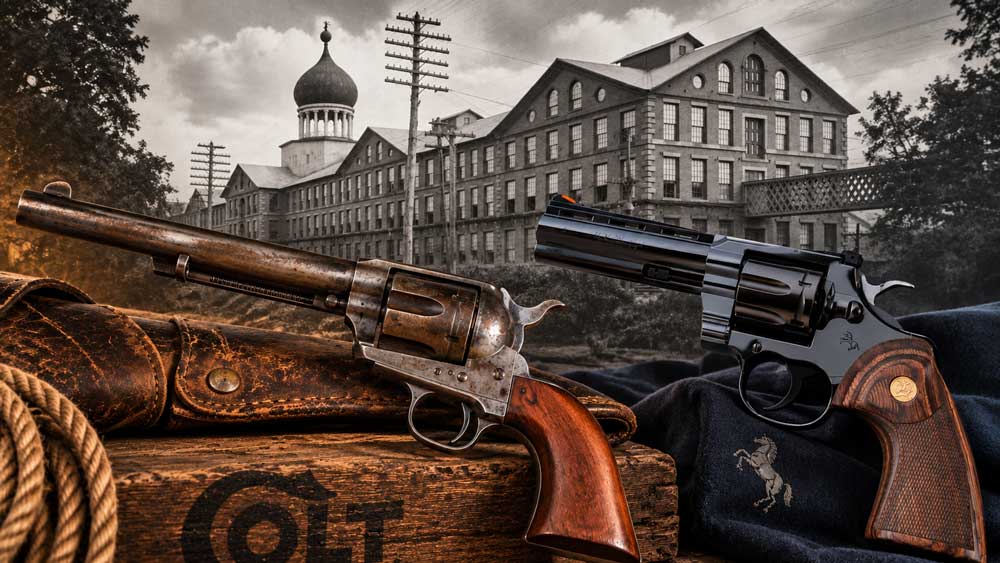
For nearly two centuries, the name Colt has been woven into the history of American firearms.
Samuel Colt’s revolvers accompanied soldiers, lawmen, outlaws and settlers across a changing nation. The Colt Single Action Army became one of the defining firearms of the American West. The Model 1911 served generations of American servicemen. Later came the Python, the M16 and other firearms that helped carry the Colt name into entirely different eras.
But history alone doesn’t guarantee a future.
And Colt knows it.
During a recent industry presentation, Shane Wheaton, Vice President of Colt’s Commercial Sales Division, offered an unusually candid assessment of where the company has been, where it went wrong and what is now happening behind the scenes.
His message was essentially this: Colt is rebuilding.
The more interesting question is what Colt will look like when that rebuilding is finished.
From Survival to a New Chapter
Colt’s troubles aren’t exactly a secret.
Wheaton described a period marked by the loss of major government business, labor problems, bankruptcy, restructuring and a shortage of capital. In his assessment, Colt eventually reached a point where the company had lost some of its direction.
The return of the Python in 2020 was an important turning point.
But an even larger change arrived in 2021 when Česká zbrojovka Group acquired Colt. The parent company subsequently became Colt CZ Group.
At first, Wheaton admitted, he had some of the same reaction many American shooters had to seeing one of America’s most historic firearms companies acquired by a foreign company.
Once inside the organization, however, he came to see the combination differently.
CZ and Colt have relatively little product overlap. CZ has strong positions in polymer pistols, bolt-action rifles and modern military and law-enforcement firearms. Colt remains strongly identified with revolvers, 1911 pistols and AR-pattern rifles.
More importantly for Colt, its new parent brought something the company badly needed: investment.
Wheaton said Colt now has a healthy balance sheet and a parent company willing to inject serious capital into machinery, personnel and product development.
There is independent evidence that investment is needed.
Colt CZ Group reported that its worldwide revenue increased 4.6 percent in 2025 to CZK 23.4 billion. The United States was a notable exception. U.S. revenue declined 23.8 percent, with the company citing weakness in the American commercial firearms market, the federal government shutdown and lower sales of Colt-branded products.
In other words, the larger Colt CZ Group is not a company fighting for survival.
But the Colt brand has work to do.
Colt Admits Its Product Line Became Stale
Perhaps the most striking part of Wheaton’s presentation was how directly he addressed Colt’s recent product problems.
Colt’s product line, he said, had become “incredibly stale.”
For years, the company simply didn’t have the capital, product-development organization or leadership structure necessary to consistently bring new firearms to market.
That appears to be changing rapidly.
According to Wheaton, Colt had only four product engineers and one product manager when he arrived approximately 18 months ago.
Today, he says the company has 22 product engineers, four product managers, project managers and a formal product-development process intended to move new ideas into production.
That is a substantial change for a company often accused by shooters of surviving primarily on products and names created decades ago.
And Wheaton acknowledges another uncomfortable reality.
A significant portion of Colt’s traditional customer base is getting older.
Many younger shooters simply don’t have the same connection to Colt that previous generations did.
Colt was late to several major developments in the modern handgun market, including concealed-carry pistols, optics-ready handguns, compensated pistols and other trends embraced by younger shooters.
The challenge now is catching up without turning Colt into just another modern firearms company.
Rebuilding the Factory
Changes are also underway on the manufacturing side.
In 2025, Colt CZ Group acquired Valley Steel Stamp of Greenfield, Massachusetts, a longtime supplier of precision firearm components.
The acquisition brought additional machining and engineering capability directly into the company.
According to Colt CZ, Valley Steel Stamp had already been supplying components including revolver frames, cylinders and other parts.
Wheaton went considerably further in describing the importance of Greenfield.
He said the facility played a major role in getting Colt back into the revolver business and today employs more than 80 highly skilled engineers and machinists. Colt has also added black-oxide bluing capability there.
Meanwhile, changes are underway at Colt’s historic West Hartford operation, including lean-manufacturing programs and new processes intended to improve manufacturing capability and product quality.
The significance isn’t simply that Colt owns another factory.
It gives the company additional American manufacturing and engineering capacity at precisely the time Colt says it intends to dramatically expand its product-development pipeline.
One Foot in the Past
For CAS City readers, however, the most interesting part of Colt’s future may be its past.
Colt still builds the Single Action Army.
More than 150 years after its introduction in 1873, new Single Action Army revolvers remain available through the Colt Custom Shop.
That alone illustrates the unusual problem Colt faces.
Few manufacturers must simultaneously serve customers interested in firearms designed during the age of the American frontier and shooters who expect optics-ready pistols, modern carry guns and the latest technology.
During the presentation, that tension produced perhaps the best description of Colt’s challenge:
One foot in the future and one foot in the past.
Wheaton clearly understands the importance of the customers who kept Colt alive through difficult years.
Those customers cannot simply be abandoned while Colt pursues younger shooters.
At the same time, nostalgia alone isn’t a long-term product strategy.
Could the Classics Return?
That creates some intriguing possibilities.
During the discussion, classic Colt revolvers including the Detective Special and Agent came up.
Wheaton didn’t announce their return.
But he did acknowledge significant opportunities for Colt in areas including concealed carry and lightweight alloy-frame revolvers.
That distinction matters.
Colt’s first wave of new products, he explained, is expected to consist largely of refreshed existing products. Truly new platforms take considerably longer — potentially several years when developed from the ground up.
The strategy appears to be incremental: improve and expand what Colt already has while developing the next generation behind the scenes.
We’ve already seen some evidence of that approach.
Colt has expanded its modern revolver family, introduced new blued versions of models including the Anaconda and King Cobra, added optics capability across more of its 1911 line and continued developing variations of established products.
Those aren’t revolutionary changes.
But they may represent the first steps toward something larger.
Getting Back Into Colt’s Lane
One of Wheaton’s most revealing comments concerned where Colt should compete.
He questioned previous efforts to push Colt into product categories such as bolt-action rifles while enormous opportunities remained inside categories historically associated with the company.
Why spend the capital and marketing effort convincing shooters to buy a Colt in a market dominated by entrenched competitors when Colt still has unexplored opportunities in revolvers, 1911s and other products consumers already associate with the Rampant Colt?
In simple terms:
Get back into Colt’s lane.
That doesn’t necessarily mean reproducing the past.
The enormous success surrounding the return of the Python demonstrated that a historic Colt name can be successfully reintroduced as a modern firearm rather than simply reproduced as a museum piece.
The same philosophy could potentially apply elsewhere in Colt’s catalog.
What Does Colt Look Like in 2030?
Nobody outside Colt knows exactly what is coming.
Wheaton indicated that additional products are under development, but the company isn’t yet ready to discuss many of them publicly.
He did offer one tantalizing prediction.
Looking three or four years into the future, he believes Colt’s product portfolio could look dramatically different from what it does today.
That’s an ambitious statement.
But for the first time in quite a while, there appears to be substantial infrastructure behind it: new ownership, capital investment, additional manufacturing capability, a greatly expanded engineering team and new leadership throughout much of the organization.
None of that guarantees success.
Colt still has to design firearms people actually want, manufacture them consistently, price them competitively and rebuild relationships with dealers, shooters and the firearms media.
Most importantly, it has to convince a generation of shooters who may recognize the Rampant Colt but have never felt any particular reason to own one.
That’s a very different challenge from selling another Python to someone who wanted one when he was 20.
The Peacemaker Still Matters
For Cowboy Action shooters, collectors and students of the Old West, Colt occupies a place few other firearms manufacturers ever can.
The Single Action Army isn’t merely another revolver in the catalog.
It represents the foundation upon which much of Colt’s identity was built.
That history is valuable — but perhaps only if Colt treats it as a foundation rather than an anchor.
The company doesn’t need to choose between the Peacemaker and whatever comes next.
It needs both.
More than 190 years after Samuel Colt began building revolvers, the company carrying his name is once again trying to reinvent itself.
Colt has done that before.
The next few years may tell us whether it can do it again.